Pump
Piston seals
The ring that keeps the solvent in the chamber while the piston moves. It wears, and it is the most common pump repair.
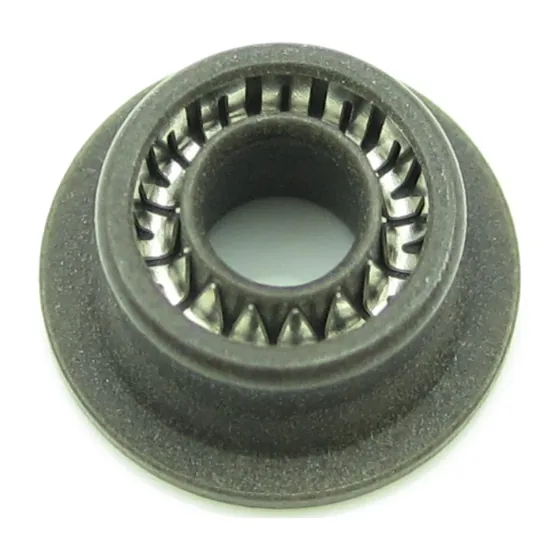 Agilent, black PTFE (standard)
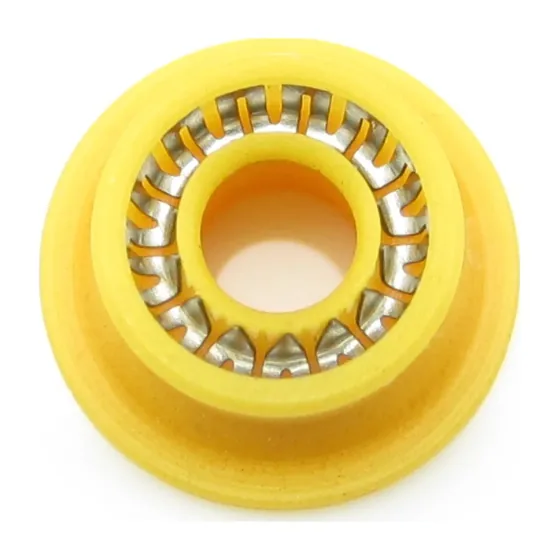 Agilent, yellow PE (normal phase)
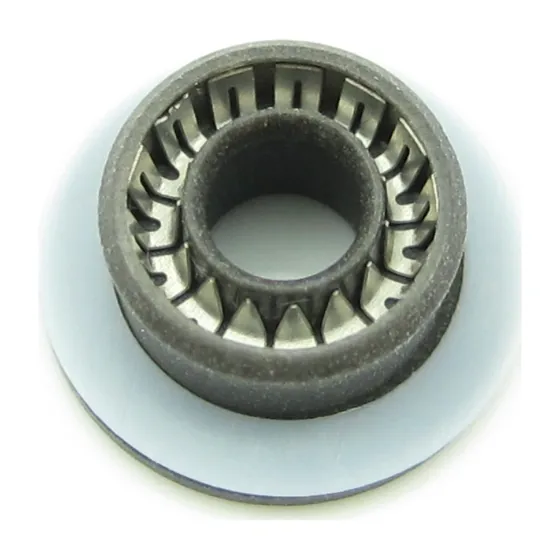 Waters 510/515/600, PTFE
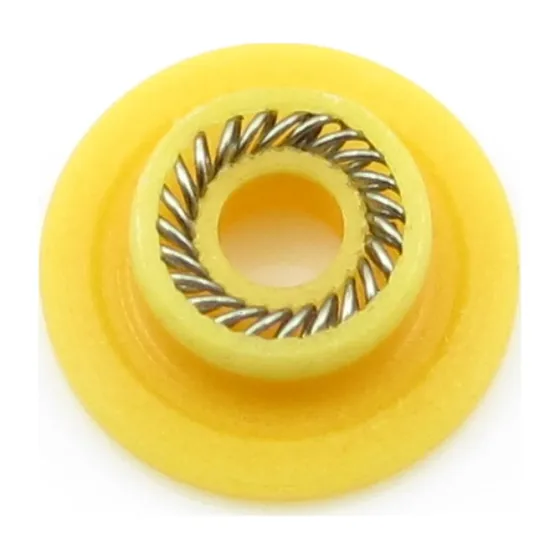 Shimadzu LC-20AD, UHMW-PE
The seal is a small ring with a lip, held against the piston by a spring. It keeps solvent in the chamber at full pressure while the piston slides through it on every stroke. It is a part that wears out by design.
The material is a trade-off, and ASI, which makes both kinds, explains it this way. PTFE is inert to every HPLC solvent and more flexible, so it seals better on a worn or poorly aligned piston, but it wears faster. UHMW-PE wears better, sheds less and lasts longer; ASI recommends it in general, except with 100% methylene chloride or toluene.
Agilent’s choice shows the same trade-off: black PTFE seals as standard on the 1260, and yellow PE seals for normal phase, because PTFE wear particles can clog valves in normal phase solvents.
The numbers
- Agilent 1260 standard
- Black PTFE piston and wash seals, with sapphire pistons, 600 bar 1
- Normal phase
- Yellow PE seals 1
- PTFE (filled)
- Inert to every HPLC solvent and more flexible, so it seals better on a worn or poorly aligned piston; wears faster 2
- UHMW-PE (compounded)
- Wears better, sheds less, acts as a bearing and lasts longer; use only now and then with 100% methylene chloride or toluene 2
- Change interval (Shimadzu LC-40D)
- 1 year, or by volume pumped: 30 L at 80 MPa (X3), 60 L at 30 MPa (XR) 4
- After fitting
- Agilent's seal wear-in procedure; change the purge valve frit too 5
Same part, different names
- Agilent
- Piston seal (1260), plunger seal (1200); wash seal on the back side 1
What goes wrong
- Pressure lower than normalCheck: A worn seal or piston. Replace the seal and inspect the piston. 3
- New seals wear out fastCheck: A worn or scratched piston, or salt on the piston. Run water through before shutting down after buffers. 3
- Black particles on fritsCheck: Normal wear from the seals. Agilent says they do not usually block the purge frit in the short term. 5
Check yourself
Tap an answer to see if you are right and why.
Go deeper
The more detailed pages (marked Students) are for students of HPLC Operation and Troubleshooting, a live group. How to become a student. Students: sign in with your email when asked.
Sources
- Agilent Technologies, Agilent InfinityLab LC Series 1260 Infinity II Isocratic and Quaternary Pumps User Manual (G7111). Materials in the flow path, p. 70; Normal phase applications, p. 82.
- Analytical Scientific Instruments (ASI), Selection Guide for material of pistons and seals. Selecting the best material for your application, p. 1.
- Analytical Scientific Instruments (ASI), Trouble Shooting Guide: pump replacement parts (white page). Operating pressure lower than normal and Seal life unusually short, pp. 3-4.
- Shimadzu, LC-40D X3 CL / LC-40D XR CL Solvent Delivery Module Instruction Manual (228-97197). List of periodic inspection and maintenance, p. 82.
- Agilent Technologies, Agilent 1200 Series Quaternary Pump User Manual (G1311-90011). Operational hints, p. 50; Algae growth in HPLC systems, pp. 53-54.
New modules by email
All the modules are open now, and I keep adding parts and checks. Leave your email and I will send you what's new, including the Empower pages.
My HPLC newsletter too, about once a week. Unsubscribe any time. Privacy