Module
Solvent delivery
The bottles, the inlet filters, the solvent lines and the degasser. Everything before the pump.
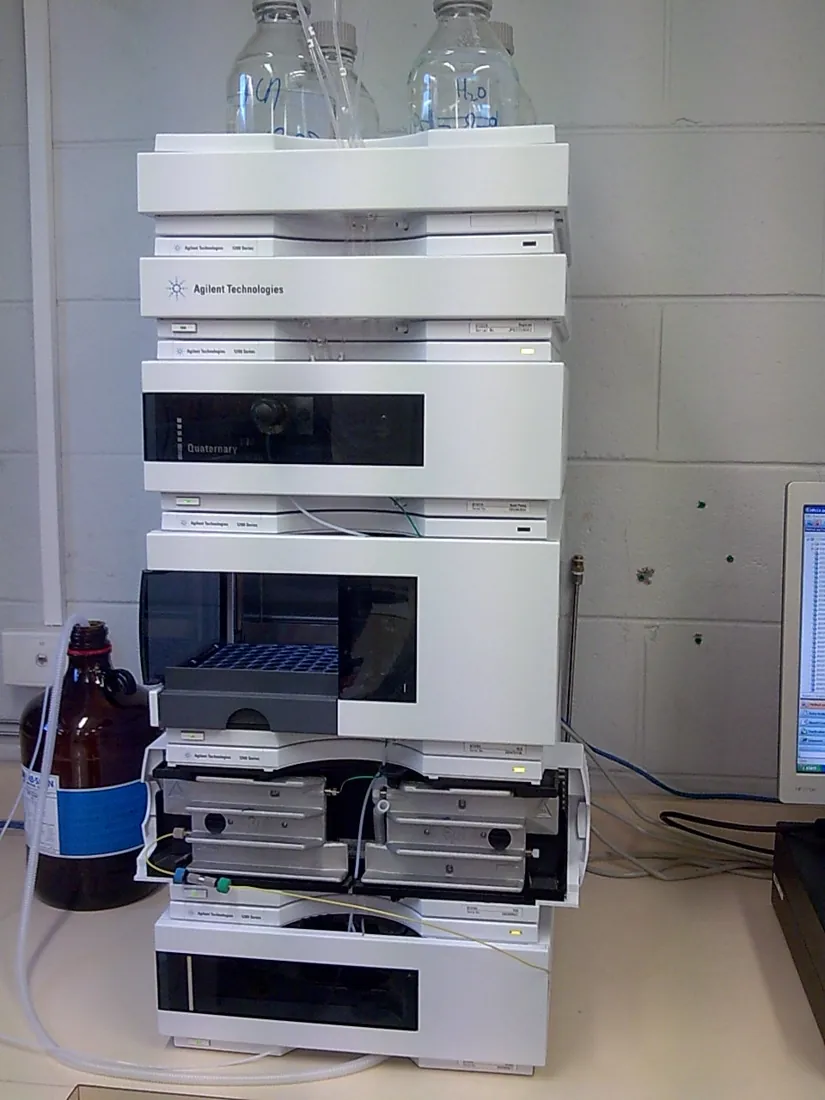
This is where the mobile phase waits before the pump pulls it in. It looks simple, a few bottles on a tray. But some pump problems start here, for example a blocked inlet filter, algae in an aqueous bottle or air in a line.
Follow one line from the bottle. The inlet filter sits at the bottom of the bottle. The solvent line goes up through the cap to the degasser, and from there to the pump.
What goes wrong
- Pressure goes up and down now and then, or the gradient looks wrongCheck: A partly blocked inlet filter. Agilent says this is harder to find than a fully blocked one. 1
- Air bubbles in the lines or the reservoirsCheck: Are the bottles below the pump? Thermo asks for the same level or higher. 2
- The degasser is not removing enough gasCheck: Dirty line connectors. Thermo says even small particles can let air into the degasser. 2
Module check
8 free questions on the parts of this module. Tap an answer, or a part of the drawing, to see if you are right and why.
Students get the full module test, with harder questions from real lab situations, and their scores saved. Students: take the module test. Not a student yet? See how to join.
Ready for the full module test? Harder questions from real lab situations, and your best score is saved. Take the module test →
Go deeper
- Solvent bottles Glass bottles that hold the mobile phase, one bottle per solvent channel.
- Bottle caps The cap holds the solvent lines in the bottle. A closed safety cap with a vent valve also keeps vapour in and dust out.
- Mobile phase in the bottle What you put in the bottle decides how long the filters, check valves and seals last.
- Inlet filter A small filter on the end of each solvent line, at the bottom of the bottle. Glass, stainless steel or PEEK, usually 10 to 20 µm.
- Solvent lines Low-pressure PTFE tubing from each bottle to the degasser and the pump.
- Degasser Takes dissolved air out of the mobile phase before it reaches the pump.
Sources
- Agilent Technologies, Agilent 1200 Series Quaternary Pump User Manual (G1311-90011). Algae growth in HPLC systems, pp. 53-54.
- Thermo Fisher Scientific, UltiMate 3000 Series SD, RS, BM and BX Pumps, Operating Instructions (4820.4001). Section 4.3, Solvent reservoirs, pp. 58-59.
New modules by email
All the modules are open now, and I keep adding parts and checks. Leave your email and I will send you what's new, including the Empower pages.
My HPLC newsletter too, about once a week. Unsubscribe any time. Privacy