Solvent delivery
Solvent bottles
Glass bottles that hold the mobile phase, one bottle per solvent channel.
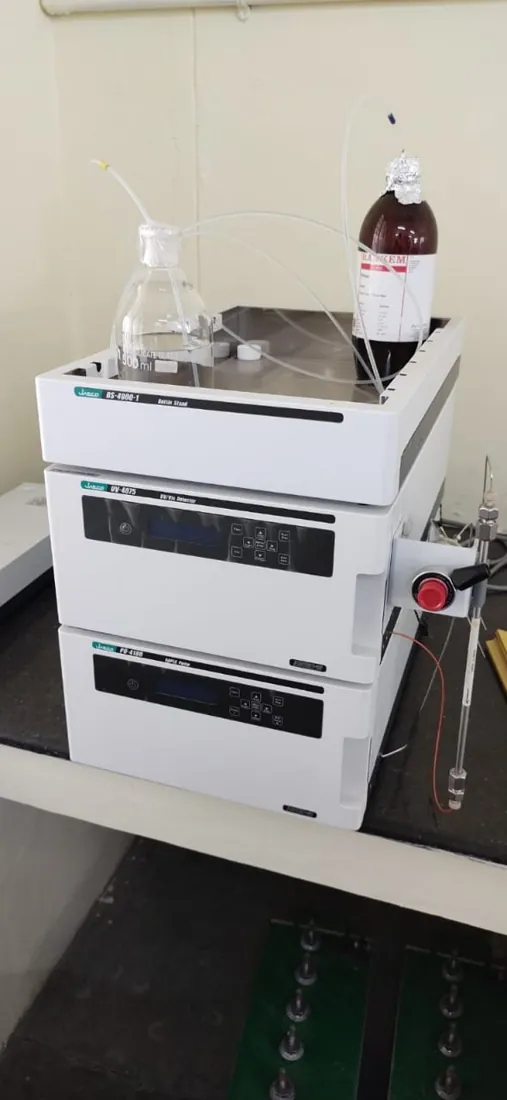
A quaternary pump mixes up to 4 solvents, so it has up to 4 bottles, called A, B, C and D.
The bottles sit on top of the pump on purpose. Agilent says to place the solvent cabinet on top of the pump or higher. Thermo says the same, and gives the reason: a bottle lower than the pump lets air bubbles form in the reservoir and in the solvent.
The aqueous bottle needs the most care, because water and buffers are where algae grow. See Bottle hygiene.
The numbers
Same part, different names
What goes wrong
- Air bubbles form in the reservoirs and in the solventCheck: Bottles lower than the pump. Thermo's reason for keeping them at the same level or higher is to avoid this. 3
- Inlet filters block quickly on the aqueous channelCheck: Algae. Agilent asks for an amber bottle, out of direct sunlight, for aqueous phase. 2
Check yourself
Tap an answer to see if you are right and why.
Go deeper
The more detailed pages (marked Students) are for students of HPLC Operation and Troubleshooting, a live group. How to become a student. Students: sign in with your email when asked.
Sources
- Agilent Technologies, Agilent InfinityLab LC Series 1260 Infinity II Isocratic and Quaternary Pumps User Manual (G7111). Overview of the hydraulic path, p. 19, and specifications (4-channel degassing), PDF p. 42.
- Agilent Technologies, Agilent 1200 Series Quaternary Pump User Manual (G1311-90011). Operational hints, p. 50; Prevent blocking of solvent filters, p. 52.
- Thermo Fisher Scientific, UltiMate 3000 Series SD, RS, BM and BX Pumps, Operating Instructions (4820.4001). Section 4.3, Solvent reservoirs, pp. 58-59.
New modules by email
All the modules are open now, and I keep adding parts and checks. Leave your email and I will send you what's new, including the Empower pages.
My HPLC newsletter too, about once a week. Unsubscribe any time. Privacy