Solvent delivery
Inlet filter
A small filter on the end of each solvent line, at the bottom of the bottle. Glass, stainless steel or PEEK, usually 10 to 20 µm.
The inlet filter stops particles in the bottle from reaching the pump. ASI, a check valve maker, says contamination can seriously impair the check valves, and Agilent says small particles can permanently block capillaries and valves.
Agilent’s manuals ask for both: filter the solvent, and never run the pump without an inlet filter on the line.
Every maker sells several versions. The drawing above shows the four you will meet most: glass, stainless steel, PEEK and the larger preparative filter. The numbers on this page come from Agilent, Thermo, Waters, Shimadzu, ASI and Restek, so you can compare.
Agilent describes the inlet filter as the first barrier for particles, precipitates and microbes. The pore size is a balance: too large and it lets particles through, too small and it raises the pressure on the suction side and the pump struggles to fill.
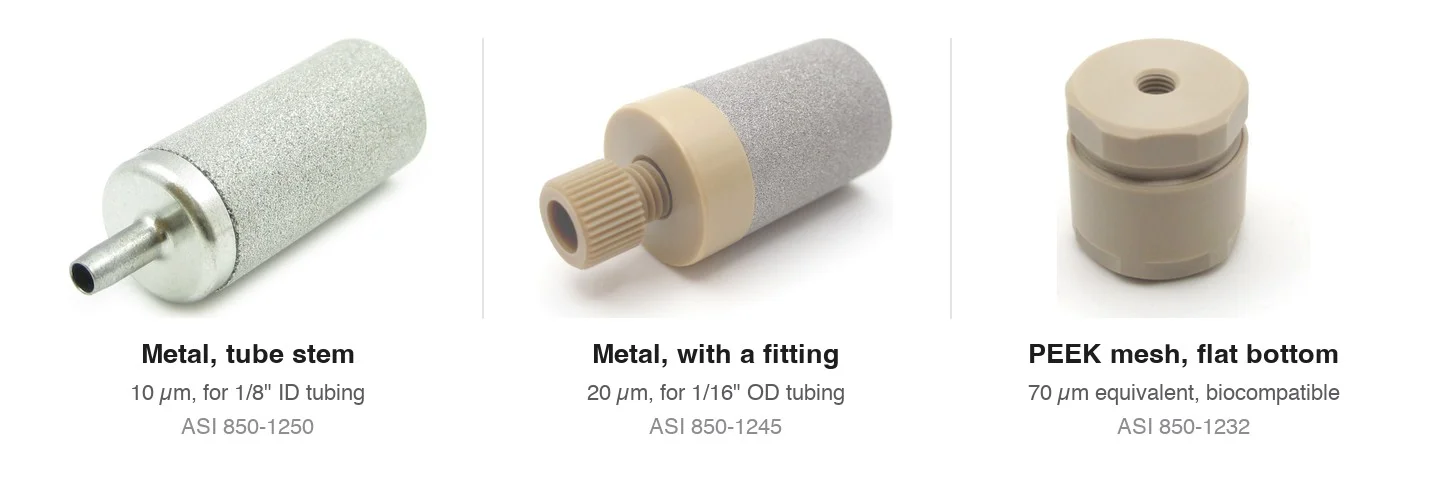
The shape changes too. The photo shows three from ASI: two metal filters, one with a tube stem and one with a fitting, and a flat-bottom PEEK mesh filter for biocompatible systems. ASI suggests 10 µm for most analytical work and 20 µm above 10 mL/min, so the pump does not cavitate.
You only see it when you lift the line out of the bottle, so it is easy to forget.
The numbers
- Pore size, Agilent
- 20 µm (solvent inlet filter 5041-2168) 1
- Pore size, Restek
- 15 µm borosilicate glass frit 6
- Range from one maker
- Agilent lists glass (20 µm), stainless steel (12 to 14 µm), PEEK (10 µm) and preparative versions (20 µm steel, 40 µm glass) 9
- Material
- Stainless steel frits are standard in Thermo's UltiMate 3000 solvent rack kit 3
- Material
- Waters lists stainless steel reservoir filters for the Alliance e2695 5
- Fits
- Standard 1/8" OD (3.2 mm) PTFE tubing, through a frit adapter 6
- Pore size rule of thumb
- 10 µm or finer on the solvent intake line (ASI) 7
- Replace (Shimadzu LC-40D)
- Every 2 years, or sooner when particulates clog it 8
- Pore size by flow (ASI)
- 10 µm for most analytical work; 20 µm above 10 mL/min, to avoid pump cavitation 10
- Biocompatible versions (ASI)
- Flat-bottom filters with PTFE mesh (20 µm equivalent) or PEEK mesh (70 µm equivalent) 10
Same part, different names
What goes wrong
Check yourself
Tap an answer to see if you are right and why.
Go deeper
- Filter materials and shapesStudents Glass, stainless steel, PEEK and preparative filters. The material follows the pump and the method; the shape decides how much solvent you can use.
- Pore size: 10, 15 or 20 µmStudents 10 to 20 µm in the documents here. Much coarser than the 0.45 µm filter you use on buffers.
- Is the filter blocked? The drip testStudents Disconnect the line at the pump and watch it drip. A good filter drips freely.
The more detailed pages (marked Students) are for students of HPLC Operation and Troubleshooting, a live group. How to become a student. Students: sign in with your email when asked.
Sources
- Agilent Technologies, Agilent InfinityLab LC Series 1260 Infinity II Isocratic and Quaternary Pumps User Manual (G7111). Checking and replacing the solvent filter, p. 139; Parts: bottle head assembly, p. 183.
- Agilent Technologies, Agilent 1200 Series Quaternary Pump User Manual (G1311-90011). Solvent information, p. 51; Algae growth in HPLC systems, pp. 53-54.
- Thermo Fisher Scientific, UltiMate 3000 Series SD, RS, BM and BX Pumps, Operating Instructions (4820.4001). Section 4.3.1, General notes, pp. 58-59.
- Waters Corporation, ACQUITY UPLC System Operator's Guide (71500082502 Rev. F). Replacing solvent filters, p. 6-49.
- Waters Corporation, Alliance e2695 Separations Module Operator's Guide (715003794 Rev. B). Appendix C, Solvent management system spare parts, p. 283.
- Restek, 2021, Effective LC Troubleshooting: Symptom-Based Strategies and Solutions (GNAR3485), product pages. Bluestem glass solvent filter, product page, PDF p. 10 (vendor describing its own product).
- Analytical Scientific Instruments (ASI), Maintenance and Trouble Shooting Tips for Replacement Parts (white page). Keeping them clean, item 1, p. 1.
- Shimadzu, LC-40D X3 CL / LC-40D XR CL Solvent Delivery Module Instruction Manual (228-97197). List of periodic inspection and maintenance, p. 82.
- Agilent Technologies, HPLC Solvent Inlet Filters (product page, read 22 Nov 2026). HPLC solvent inlet filters, product page: overview, How it works, product list.
- ASI (Analytical Scientific Instruments US), Solvent Filters (product page, read 22 Nov 2026). Solvent filters, product page: overview and product list (maker describing its own products).
New modules by email
All the modules are open now, and I keep adding parts and checks. Leave your email and I will send you what's new, including the Empower pages.
My HPLC newsletter too, about once a week. Unsubscribe any time. Privacy